
2013: The Year in Conlanging
This past year had some great conlanging activity. Here’s a round-up of some of the highlights:
- Games of Thrones, Season 3, premiered in March. With this season, we got a little less Dothraki but also go to hear High Valyrian thanks to David J. Peterson. Especially with the awe-inspiring episode And Now His Watch is Ended! Dracarys!
- Also, thanks to David, we got conlangs in the new Syfy TV series Defiance which premiered in April. Castithan and Irathient got a following rather quickly!
- Man of Steel, released in June, featured Kryptonian created by Christine Schreyer.
- The opening of the LCS Lending Library in September (Edit: added 12/27/2013)
- In November, Thor: The Dark World was released which featured extensive dialogue from Malekith and Algrim/Kurse in David’s Dark Elvish (or Shiväisith).
- Also in November, Mark Rosenfelder (aka Zompist) published his follow-up to the LCK and Advanced LCK: The Conlanger’s Lexipedia.
- In 2013, Zompist also worked on the the conlang for Serpent’s Tongue, Sehimu Thinara. His blog post includes a link to a grammatical sketch of the language.
- The Hobbit: The Desolation of Smaug was released in December with quite a bit of dialogue in Elvish and Orkish.
- It was also announced that David would be doing the alien language for the CW TV series Star-Crossed.
Have I missed one? (Undoubtedly.) Feel free to add a comment to this post!
Happy conlanging in 2014!
The Hobbit: The Desolation of Peter Jackson
(Yes, I know it’s been a year since I posted anything here. Tempus fugit!)
desolation: devasation; ruin.
I had the experience of finally getting around to going to the theater recently and seeing (HFR 3D again) Peter Jackson’s most recent installment of The Hobbit epic, The Desolation of Smaug. I posted a review of the first film back on December 16, 2012. First, as stated in that year-old review:
SPOILERS! SPOILERS! SPOILERS! SPOILERS! SPOILERS! SPOILERS! SPOILERS! SPOILERS! SPOILERS!
You have been warned…
In re-reading that same review, I’m reconsidering a few statements made in 2012:
- I’m planning on seeing the next two without question. I may be re-considering this, although I will (in the end) most likely see There and Back Again next year.
- There were some parts that dragged on too long (more on that below) and some superfluous material,… My word, this year this goes double.
- but, overall, it kept my attention, …snooore…Oh, I’m sorry, nodded off there…uh, yeah, not so much this year.
Okay, so that being said, what did I like in The Desolation of Smaug. This won’t be a long list:
- Legolas: His presence in the movie was fine. After all, the Elvenking is his father; Legolas is a prince of the Woodland Realm. I’ll get into misgivings about Legolas below.
- Tauriel: Believe it or not I was okay with Jackson’s made-up character. She conveyed the difference between the ruling Sindarin family and the Silvan Elf population quite nicely.
- The Spiders: The evil insects and Bilbo’s initial encounter were spot on. I found it interesting that Bilbo could only understand the spider’s language after he put on the Ring.
- Laketown: The town itself was an Alan Lee/John Howe art-piece come to life.
- Bilbo’s initial encounter with Smaug: The first few minutes were great.
- Languages: As usual, I enjoyed hearing faux Tolkien languages (or maybe neo-Tolkien languages) used on screen. For some misgivings, see below.
- Bard: The Lake-man actually comes off alright, but once again a little too much Jackson-inspired backstory.
And that’s about it. It will say that it was nice to see Beorn represented (What was up with the eyebrows??), but he was introduced so suddenly and then exited so suddenly, he seemed far too superfluous. Undoubtedly, he is just being set up for an appearance at the Battle of Five Armies. By that time, many will simply say, “Where did this bear-guy come from?”
Unfortunately, and I say this as one who was hoping for the best, the movie was somewhat forgettable. I just saw it a few days ago, and even now it just collapses into a senseless, 2-hour-40-minute action sequence. I’ve read some reviews that tout this as a ripping, adventure-packed follow-up, and, yes, it is “adventure-packed” but the film rarely stops to take a breath. The characters are running and running and running some more. Quick scene, then back to the running.
Let me address some of those misgivings mentioned above. The barrel-riding sequence seemed interminable! Having the dwarves ride in open barrels was the first faux pas in my opinion. Rhett Allain over at Wired has written a great piece about the issues with standing up in floating barrels. I realize they had to be open to do the whole fighting sequence, but they really shouldn’t have. The dwarves, orcs, and elves action-sequence here went from bad to worse. And Bombur with his spinning arms-poking-out-of-the-barrel move was where I really started to just shake my head and sink further down in my seat.
When the orcs fell through the ceiling of Bard’s house in Laketown, I just started laughing. That was my true WTF moment! It was all just too farcical. The subsequent fight through Laketown by the orcs, then Bard being chased by the Master’s men, then… it was just all too much.
And then we come to the dwarves escapade on the Lonely Mountain. I was with them up for awhile. Even the suspenseful bit with the moon being the “last light” of Durin’s Day worked for me. Thorin’s big old boot saving the key. Nice cinematic touch. Bilbo going down the tunnel, meeting Smaug, the brief interchange between them…. then again… WTF? During the loooooong encounter with Smaug and the dwarves racing around, I kept expecting the score to break into the Benny Hill theme. (aka Yakety Sax). Oh, my, and the whole thing with the forges (I’ll admit it was cool to see the Forges of Erebor lighted up but what came next… shudder). And then trying to drown Smaug in gold??? I realize this was a little homage to Smaug’s epithet as “the Golden” but… really?! That’s how Jackson fits it in? Wired‘s Allain does a great piece about the melting gold, too.
The conlangs? Always nice to hear a well-developed conlang in a film but consider this? Why do Legolas and Tauriel seem to constantly switch back and forth between Sindarin and English (presumably meant to equate to Common Speech/Westron)? If they’re just talking between themselves, why not just speak in their first language? Same way with the orcs. Sometimes they use Black Speech/Orkish, sometimes the Common Speech? Pick one and stick with it! For additional info on the conlangs, check out David Salo’s blog that covers Black Speech, Elvish, Khuzdul, and Orkish.
This movie was such a disappointment. I was ready for Jackson fan-fiction. Even the dwarf-elf “love story” but even taken from a cinematic perspective, there were so many lost opportunities as well as long sequences that did nothing to advance the plot (like Beorn’s segment). Others have pointed out the movie’s shortcomings, including The Top 5 Most Preposterous Scenes in The Desolation of Smaug, The Hobbit 2 is Bad Fan Fiction, and The 6 Most Pointless Scenes in The Desolation of Smaug so there’s no need to belabor the point. Suffice to say, I’d really like to see the Smaug get stuck by Bard and the Battle of Five Armies (and Gandalf stopping it)… but seeing those scenes through Peter Jackson’s distorted lens may just be too much. I guess we’ll see when Hobbit 3 comes to theaters next year. (Fingers crossed)
2012: The Year in Conlanging
It seemed to me that there was a flurry of conlang-related activity during the latter part of 2012, so I decided to take a look back and see if any other significant events in conlangs and conlanging took place this past year. Turns out, there were quite a few. I’m sure I forgot any number. Feel free to add others as comments to this post.
Enjoy the list and happy conlanging in 2013!
- John Carter, based (loosely) on the Edgar Rice Burrough’s series of novels, premiered on March 9, and featured a Barsoomian (Martian) language created by Na’vi creator, Paul Frommer. The film touched off a series of posts on this blog on the Barsoomian language.
- Also back in March, David Peterson (creator of Dothraki, LCS President, and all-around good guy) did an AMA (Ask Me Anything) on reddit.
- Mark Rosenfelder (aka Zompist) published his Advanced Language Construction Kit in July. Zompist’s online Language Construction Kit continues to be a good first stop for budding conlangers.
- Dr. Christine Schreyer’s ANTH474 class (Pidgins, Creoles, and Created Language) at the University of British Columbia, Okanagan Campus, was offered in the Spring 2012 semester. Yours truly had the honor of speaking (via Skype) to the class on November 1 about the LCS, the Esperanto, Elvish, and Beyond exhibit, and my own conlanging efforts. Through her active twitter feed and the hashtag #ANTH474, we were all able to interact with the class.
- On October 4, Dothraki gets a shout-out on Season 9, Episode 3 (Andy’s Ancesry), of NBC’s The Office (video). David Peterson himself blogged about the epidose and even canonized the noun-verb compound concept for the language using Dwight’s example.
- Also in October, the first Klingon wedding to occur in the UK took place. Neatorama has posted video coverage (along with some tlhIngan Hol).
- On Novemer 10, 2012, Pete Bleackley started the Conlang Tip Exchange over on Google+.
- Registration for the 5th Language Creation Conference opened. LCC5 will take place on May 4 & 5, 2013, in Austin, Texas, and presentation proposals are still being accepted.
- A Klingon Christmas Carol was performed during the month of December in Chicago at the Raven Theatre by Commedia Beauregard. According to its Wikipedia entry, the play “was written by Christopher O. Kidder and Sasha Walloch and was originally translated by Laura Thurston, Bill Hedrick and Christopher O. Kidder. Additional content and translations were provided by Chris Lipscombe.” The 2012 production received positive reviews like this and this. Qapla’!
- On December 3, Stephen Colbert kicks off Hobbit Week on The Colbert Report with “Elen sÃla lumenn’ omentielvo.”
- The Hobbit: An Unexpected Journey, the first of Peter Jackson’s planned prequel trilogy, opened on December 14. The film featured dialogue in Sindarin and an Orcish dialect. As of December 31, the film has grossed $360,903,000.
- The idea of creating a new word for your conlang on every day of December was inaugurated by Mia Soderquist on Twitter with the following tweet on November 21: “I am suddenly inspired to create a common word for each day in December, just to start filling more obvious gaps.” Leland Paul Kusmer suggested “Lexicon December = Lexcember, perhaps?” and thus #lexember was born.
- On December 24, Joshua Foer‘s article (Utopian for Beginners) on John Quijada and Ithkuil was posted online at The New Yorker. Subsequently, a podast with Foer was posted (Out Loud: Unspeakable Language) that touched on aspects of the original article.
Another Conlang Holiday Card!
I received my 2nd conlang holiday card in the exchange. This one is from Padraic Brown, with a conlang and a conculture!
The front cover…

The inside panel…
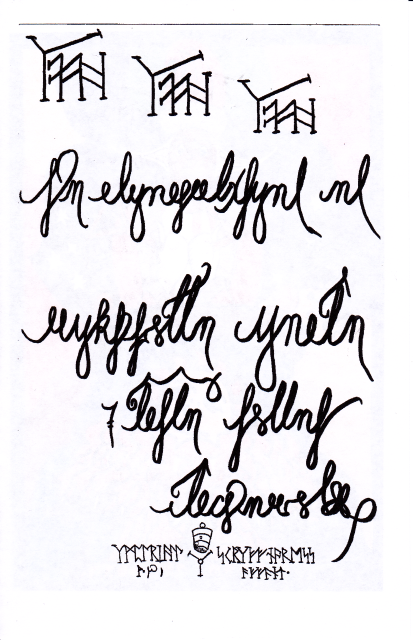
Translation…

Concultural explanation…
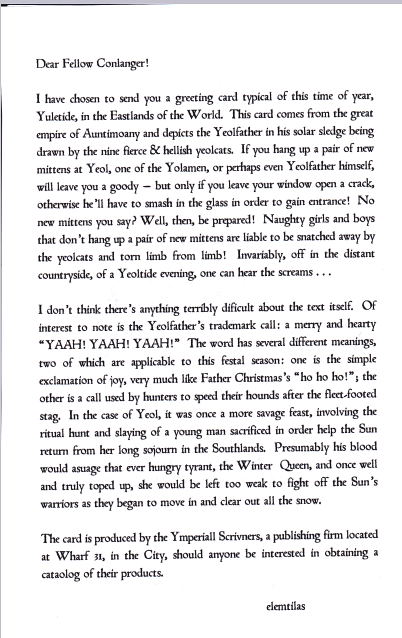
Holiday Conlang Card Exchange
I decided to take part in the Holiday Conlang Card Exchange this year and put my submission in for sharing with two people. Of course, this also means I receive cards as well. Here is the card I just received from Sylvia Sotomayor with her Kēlen:
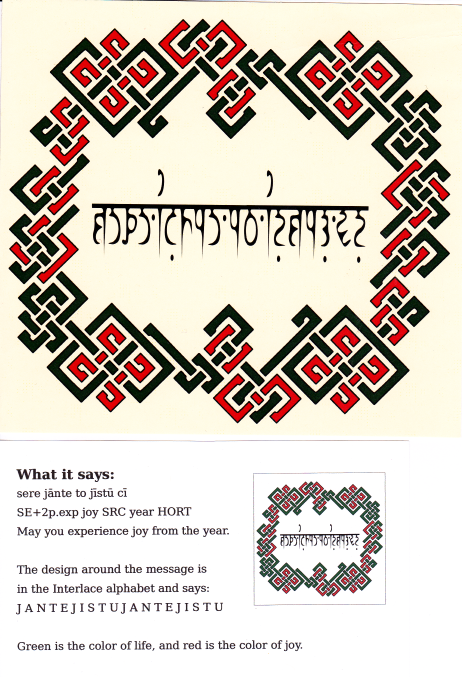
This image includes the card (top) and Sylvia’s explanation (bottom). Unfortunately, the green interlace did not come out as nice as I would have liked on my scan, but, nonetheless, it’s a beautiful design… made even cooler by the fact that the interlace design is a script as well! Kēlen is an inspiration. Thanks, Sylvia!
My own cards I sent out are not nearly as polished. Here is the front panel of both (They ended up being tri-fold):
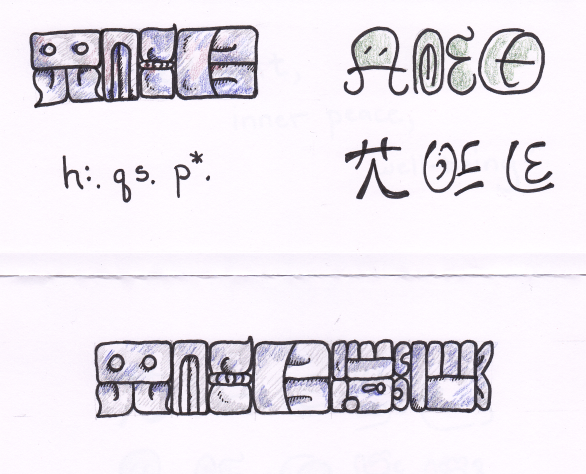
These are written in a new script I’ve been devising for my Drushek language known as Dritok (or r’.z*w. in proper transcription style). Before the cards, the script had not seen light outside my notebooks, so, tah dah! The word h:.qs.p*. means “contentment, inner peace, restful mind, etc.”. The segment qs. has to do with “mental states.” The top image has the word written in three different scripts. The full phrase on the bottom image is h:.qs.p*.=D4/I1=D2 and means (roughly) “May contentment be within you” (a customary Drushek greeting and farewell). As some may already know, the D4, I1, and D2 are gestures within the language and h:.qs.p*. is vocalized. I’ve been giving Dritok a lot of thought lately and may be posting more to my (woefully under-utilized) Kryslan blog.
In any case, here’s to a happy holidays to all and may your conlanging projects be fruitful in the coming new year 🙂
The Hobbit: An Unexpected Journey – A Review
SPOILERS! SPOILERS! SPOILERS! SPOILERS! SPOILERS! SPOILERS! SPOILERS! SPOILERS! SPOILERS!
DID I MENTION SPOILERS!
YOU SHOULD NOT PASS… if you haven’t seen the movie and want to be surprised.
You have been warned…
Okay, the disclaimer is out of the way. Today, I went with the family to see The Hobbit: An Unexpected Journey, the 3-D HFR version. Having now seen it, I’m surprised at the vitriol that’s been heaped on the movie by some (e.g., here and here just to name two). Maybe “vitriol” is too strong a word, but it seems some of the negative press is unwarranted. I’ve also seen Tolkien fans that have written reviews saying they’re not even going to see movies two and three in this trilogy. I’m planning on seeing the next two without question. To me, An Unexpected Journey seemed like a quick three hours. There were some parts that dragged on too long (more on that below) and some superfluous material, but, overall, it kept my attention, didn’t offend my sensitive Tolkien sensibilities (too much – again, see below), and was a fairly enjoyable and entertaining ride. I just have to remember that any shortcomings of the film in no detract from Tolkien’s work and world. The films aren’t canon. They’re based on an interpretation of Tolkien’s work and can stand or fall on their own.
Some of the best parts, in my opinion, in no particular order were:
- The scenes inside Bilbo’s hobbit hole. These were, for the most part, true to the book (in spirit if not literally). I’ve read some reviews that talk negatively about the dishwashing sequence but found this to be very faithful to the book itself.
- Elrond showing up in his armor. No, it wasn’t in the book, but it always bothered me that Rivendell was supposed to be this idyllic sanctuary in the mountains. How did it stay safe? Well, it makes sense that Elrond and his house would ride out once in a while to “take care of business” in the neighborhood. Plus we got some Sindarin in here 🙂
- The opening prologue inside and around Erebor. Seeing Thrór, Thráin, and Thorin ensconced in their kingdom and getting a glimpse of Dwarven culture was very interesting. Plus this also gave us a peek at Smaug’s feet and fire. The scene with all the dwarves waiting inside Erebor as flames lick at the front door was very cool.
- Radagast. Yes, Radagast. As a character design, I thought he worked very well. I have other misgivings about him in the movie, but overall his look and action seemed very in keeping with what I had always thought about the brown wizard.
- Seeing the progression of Balin from Erebor, to Azanulbizar, to the “present”. The only issue here (literal book-wise) is that Thorin is actually older than Balin: Thorin was 24 when Smaug attacked Erebor; Balin was 7.
- Gandalf’s look on his face when he finds that Saruman has shown up at Rivendell. I could almost hear a “Oh, man, it’s my boss.”
- Gollum and riddle game. This was worth seeing the HFR version right here! Gollum is absolutely amazing looking, and Andy Serkis is in full command of bringing Gollum to life.
Before we go any further, let me address the conlanging aspect of the movie. There was some Sindarin in Rivendell. It’s always nice to be able to pick up a word here and there. I got Gandalf’s “Mellon nin!” even before I read the subtitle. Yay, me. I was very disappointed I didn’t hear any Khuzdul (except maybe a snippet from Bifur). However, as I was given a heads-up by Erunno Alcarinollo on Twitter, I expected a lack of Khuzdul and that the orcs seem to be speaking the Black Speech or at least some orcish dialect of it. Interesting turn of events when both the elves and the orcs get subtitles. But it’s not all the orcs. The goblins of the Misty Mountains still speak English with a British accent although they know the ones who speak only Black Speech. (We know this because the Goblin King is going to send a message to the leader of the Black Speech orcs.) And even the Black-Speech-speaking orcs seem to have some auto-tune reverb thing going on with their voices. I am looking forward to some notes online on the Black Speech in the film.
I’m going to assume that Black Speech and Khuzdul maybe sounded too much alike to do them both in the film. Plus, some movie-goers may have said, “Okay, the dwarves were speaking with subtitles before but now they’re speaking in English. What’s up with that? And why are those orcs speaking the dwarves’ language? I don’t get it!” So, I’m going to cut some slack to Peter Jackson and let the Khuzdul go. However, I still want to hear a “Baruk Khazâd! Khazâd aimênu” at the Battle of Five Armies, most likely from the armies of the Iron Hills.
Okay, so that brings us back to this band of Black-Speech-speaking orcs and their leader, Azog. Yes, that Azog. We see him, Thorin, and Balin in the Battle of Azanulbizar. I was really looking forward to this but found the movie adaptation somewhat disappointing. Azog, referred to subsequently in the film as the Pale Orc, becomes the primary antagonist of Thorin & Company because of an extreme hatred of Thorin himself. It seems… SPOILER! again… after Azog beheads Thrór in the battle (not as in the Appendices), Thorin battles the orc chieftain and cuts off the orc’s forearm. Inexplicably, the orcs carry their leader back into Moria, the dwarves claim victory, and Thorin assumes Azog dies. Bad move, Mr. Oakenshield. Azog sticks an iron claw on his forearm (with a nice spike sticking out of his elbow) and swears vengeance on the “Dwarf-scum” or whatever Black Speech phrase means that.
The creation of Azog’s revenge seems to be a superfluous sub-plot for the film. If Peter Jackson did want to have this storyline, it seems a better tactic might have been to have Azog fighting at Azanulbizar with his son Bolg. I don’t know how you show this, but having Azog kill Thrór, then have Thorin kill Azog (yes, I know he didn’t kill Azog but I’ll give them some leeway here), and have Bolg retreat (maybe with the look in his eyes as the orcs of Mordor when the Rohirrim rode down on them in Pelennor Fields in The Return of the King). But showing an orc swearing revenge on someone who slew his father might be ascribing too many emotions to orcs (who are really the expendable Star-Wars-stormtroopers or battle droids of The Lord of the Rings films).
And Azog really does look like a very good CG video game character, but a CG video game character nonetheless. If they were going with an orc antagonist, it would have been nice to see something like Lurtz. I do have to agree with those who have mentioned that aspect of the movie.
I mentioned above that I enjoyed the look and behavior of Radagast. I still stand by that. My only beef with Radagast in the film was the… SPOILER! again… rabbit-sled race to distract the orc band. “These are Rhosgobel rabbits!” I don’t even know what that means? He breeds super rabbits? And the sled just goes around and around, constantly bringing the orcs back to Thorin & Company who finally find a way to escape on their own. And Radagast just disappears then. It’s really Elrond and his elves who get rid of the orcs. So, the sled race went on way too long and, in my opinion, was superfluous in the first place.
Another part that went on a little too long was the Stone-giants scene in the Misty Mountains. I’m fine with them being in the film, but it seemed prolonged and didn’t really move the story forward. A few boulders crashing through the rain and knocking debris down on the company would have been plenty.
Just a brief note on the HFR: It didn’t really thrill me nor distract me. Maybe I’m just jaded from watching HDTV at home. Other than seeing the weave of Bilbo’s shirt and an absolutely stunning, crisp Gollum in all his slimy paleness, the HFR was just fine but nothing to get really worked up about (positively or negatively).
So, as you can see there were some disappointments but some absolutely enchanting moments, too. It could have been a great movie, but it wasn’t a failure as some seem to have suggested. Even with what I know of Peter Jackson’s additions and alterations, I’m still looking forward to seeing The Desolation of Smaug and There and Back Again.
Thoughts on The Lord of the Rings Marathon
Yesterday, I attended The Lord of the Rings Marathon at my local movie theater. This was an all-day showing of each of Peter Jackson’s films based on Toikien’s magnum opus from 11:00 am to 11:30pm (with only a half hour break between each film). I also saw it with my children who never got the chance to see the films on the big screen when they were first released so that was fun, too. Viewing the film trilogy in one fell swoop was an eye-opening experience and really allowed me to see the work as a whole. I’d like to share some thoughts and favorite moments from the films. Some of these will be familiar from ten years of voluminous commentary in print and online, but this is meant to be my subjective reaction to Jackson’s opus.
There were probably around 20 to 25 people in the theater for our marathon, so it was somewhat of a shared experience. There were even a couple women who showed up in medieval gowns. Of course, no one talked to anyone else, but we all clapped when each film was over, and giggles went through the audience at several key points: Boromir’s “One does not simply walk into Mordor” line, Sam’s “PO-TA-TOES” line, Legolas’ “They’re taking the hobbits to Isengard“, and several others. My daughter and I enjoyed Elrond’s facepalm during the Council.
One of the things that struck me was the prevalence of clasped hands. Take a notice next time you happen to watch these films. I often saw one character reaching out for another’s hand and the other grasping the outstretched hand. The two biggies are Frodo rescuing Sam from the water when leaving the Fellowship, and Sam rescuing Frodo in the Sammath Naur. There are a number of others, and I wish I had kept track. One of the reasons it struck me was when it didn’t happen. When Aragorn stretches out his hand to Gríma after Théoden is ready to kill Wormtongue on the steps of Meduseld… and Gríma spits on Aragorn’s outstretched hand.
Not having viewed the trilogy for quite some time, another thing that struck me was the prevalence of tears. I knew there was crying, but, wow, that was a lot of tears over 12 hours of movies.
And the last plot device that struck me was people plunging off of cliffs. Gandalf in the first (okay, it’s a chasm but the effect’s the same); Aragorn in the second (not in the book); Denethor, Frodo and Gollum in the third (only one of those goes over in the book). Even Boromir plunged off the Falls of Rauros, but he was already dead. I may be reading too much into this, but it looked to me like Middle-earth needed a lot more signage to alert people of dangerous cliffs.
I do have some favorite moments from Jackson’s films:
- Gandalf and the Bridge of Khazad-dûm
- Gandalf driving out Saruman from Théoden
- The ride of the Rohirrim into the forces of Mordor on the Pelennor
- Any scene with Sindarin in it 🙂
There are more, but those really spring to mind. I do find it interesting that none of those first three occur in the movie exactly as they transpired in the canon. For example:
Fire came from [the Balrog’s] nostrils. But Gandalf stood firm
“You cannot pass,” he said. The orcs stood still, and a dead silence fell. “I am a servant of the Secret Fire, wielder of the flame of Anor. You cannot pass. The dark fire will not avail you, flame of Udûn. Go back to the Shadow! You cannot pass.”
…
“You cannot pass!”
Yes, a lot of the film dialogue in that scene is from the movie, but I think the change from “You cannot pass” to “You shall not pass” was a very good decision.
The episode between Gandalf and Théoden is also much more dramatic in the film than the book. The addition of Saruman’s possession of the king of Rohan appears to have helped that plot point along in the film. Kudos again to Fran Walsh, Philippa Boyens, Stephen Sinclair and Peter Jackson. Finally, the ride of the Rohirrim. One scene I did want to see there was Théoden blowing on the horn until it “burst asunder” although I realize that might be a little difficult to pull off realistically.
I do believe that Jackson absolutely got the casting spot on with Sir Ian McKellen as Gandalf the Grey and Christopher Lee as Saruman the White. In fact, McKellen’s Gandalf is one of the major reasons I can’t wait to see The Hobbit this coming week. In my opinion, Théoden, as portrayed by Bernard Hill, was also very regal and convincing. The design team also hit the nail on the head with the Black Riders, right down to the nails coming out of the bloody hooves of the horses. And Andy Serkis’ Gollum/Smeagol is always amazing (and disturbing… in a good way) to watch.
Don’t get me wrong. There are some scenes and plot points I don’t particularly like:
- Elves at Helm’s Deep: If the Elves were going to show up anywhere, it would have been to come to the aid of Minas Tirith
- Elrond himself bringing Narsil to Aragorn: This is like Capt. Kirk always having to lead the away team (Although I did go back to the book and see that Elrond’s son, Elrohir, was the one to remind Aragorn about taking the Paths of the Dead).
- The avalanche of skulls in the Paths of the Dead: WTF?
- Faramir taking Frodo, Sam, and Gollum to Osgiliath: Seemed a little needless
- Aragorn’s angst: The “book Aragorn” seemed much more sure of himself and his duty to be king
- Denethor’s death
That last one especially still bothers me. After watching it again yesterday, it seems to me that it would be easy to blame Gandalf for Denethor’s getting torched. In the film, Denethor even has a last moment of sanity looking at his son’s face before he bursts into flames and runs off the cliff. And it looked to me like Shadowfax either pushed him onto the pyre or, at the very least, Denethor was trying to get away from the rearing horse. In the book, it’s Denethor that takes the torch and leaps onto the pyre. He takes an active role in his self-immolation. In the film, it looks, in the end, to happen almost by accident.
I really enjoy the movies, but I have to remember that they’re based on Tolkien’s work. Masterfully adapted in many cases and even (gasp) improved-upon in some, but based nonetheless. I find that the films drive me back to the books and Middle-earth again, and maybe that is the most important thing. I’m fine with some people only experiencing Middle-earth through Jackson’s prism, but I would compare it to someone only knowing the Iliad through the Brad Pitt film. Yes, you can get a good idea of the characters and the plot, but there’s no substitute for returning to the source material.
Hannon le, Tolkien. Hannon le, Peter Jackson. Eglerio!
The Colbert Report… Now in Elvish!
I was inpired this week by Hobbit Week on the Colbert Report to delve into some Elvish. To be more exact, I wanted to see if I could translate the following into Quenya or Sindarin or both:
- Stephen Colbert
- The Colbert Report
- Colbert Nation
I freely admit I’m no Helge Fauskanger or MÃ¥ns Björkman, but I figured I’d do my best to puzzle through these translations. Besides, it seemed like a nice little challenge. With that admission, I am more than happy to hear suggestions for better translations. (Note: I did use Björkman’s Tengwar Eldamar for the transliterations into Tengwar below.)
To begin with: The name “Stephen”. According to Quenya Lapseparma, “Stephen” can be translated as RÃno or RÃnon for “crowned”. It appears this word is attested in Sindarin, but it appears it could be a valid word in Quenya as well. So, we’re going with that.
“Colbert” was a little trickier. The easiest thing to do was to simply go phonetically and use Colber as the Elvish equivalent since he doesn’t pronounce the final -t. I did check and -lb- does seem to be a valid consonant cluster. However, I wanted to see if we could do a full Elvish. I then tried to look up the meaning of the surname. According to this and this, the name appears to mean something like “cool-bright” or “renowned, bright, famous.” Since “bright” seemed to come up in each, I decided to investigate that angle. It appears “brightest” is ancalima which many will remember from Aiya Eärendil Elenion Ancalima! “Hail Eärendil, brightest of stars!”. So, taking the masculine ending -o, I arrived at Ancalimo as the very rough equivalent of “Colbert” thus giving RÃno Ancalimo or RÃno Colber “Stephen Colbert”.

Next came: The Colbert Report. I had “Colbert” handled from the first step. “Report” turned out to be much more difficult. I used Fauskanger’s Quenya wordlist and the Sindarin glossary from Ambar Eldaron. There does not appear to be a word for “report” so I looked up some synonyms and found the following Elvish possibilities (Q = Quenya; S = Sindarin):
- quentalë “account, history” (Q)
- quentasta *”historical account”, “any particular arrangement (by some author) of a series of records or evidences into a given historical account” (Q)
- menta “message, sending” (Q)
- canwa “announcement, order” (Q)
- siniath “tidings, news” (S)
- trenarn “tale, account” (S)
Lots of possibilities, but I decided on quentasta for the Quenya and siniath for the Sindarin: Quentasta since it involves an author (in this case, RÃno Colber) who arranges a series of records or accounts (on the show); siniath since “tidings” and “news” are pretty close to “report” at least in the sense of Colbert’s show. With that, I could now form:
I Siniath Colber “The Colbert News” (Sindarin)
I Quentasta Colberwa “The Account of Colbert” (Quenya)

I like the Quenya since both primary words end in a vowel the same way that “The Colbert Report” end in the -r sound. Of course, I could also use I Siniath Ancalimo and I Quentasta Ancalimova. Somehow, I like the Colber better.
Finally: Colbert Nation. This one had to use Colber so that was a given. The Quenya word nórë was tailor-made for this since it means “a land associated with a particular people”: I Colbernórë! However, The Colbert Nation is known to be a rowdy bunch, so I hopped over to Sindarin to find hoth as in the Glamhoth “The Yelling Horde” (orcs). Hoth has to do with a horde or host of people, so a Sindarin Colbert Nation seems to me to be better named I Colberhoth “The Colbert Horde!”
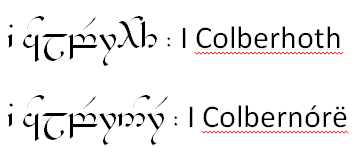
That’s my attempt! It was fun and hopefully somewhat correct 🙂
It is so refreshing to see someone revel in their Tolkien geekitude on television. As the audience says on The Colbert Report almost every night:
STEPHEN! STEPHEN! STEPHEN!… or wait, I guess that should be…
RÃNO! RÃNO! RÃNO! RÃNO!
Sira ná Hantalë!
So, today is Thanksgiving in the U.S. The title of this post is as close as I can come to “Today is Thanksgiving!” in Quenya. Hopefully, it’s correct. Since it’s a holiday and I had some time, I thought I might compose a little shout-out to what I’m appreciative of conlangery-wise (in addition, of course, to being thankful for family, health, and those things I’m thankful for every day).
I’m thankful for all the fascinating people I’ve met through conlanging, both those I’ve met personally and all those who’ve ever been ready to share their advice and knowledge through Conlang-L or other venues. Thank you all!
I’m thankful (I think “thankful” is an appropriate word) for finding a hobby/craft/art that constantly has new things to learn. I realize that’s true of most hobbies, but this happens to be the one I enjoy. Just when I think I have a handle on some aspect of language, I find another new one to explore (and to humble me). Enjoying the “multifariousness and beauty of language” (to quote The Conlang Manifesto) is one of the great things about conlanging.
I’m thankful I have the opportunity to represent the LCS as prime tweeter @fiatlingua (or is that twitterer?), secretary, and librarian. I recently had the chance to talk with Christine Schreyer‘s class via Skype about the LCS, my exhibit, and some of my conlanging efforts. I’m also writing an article on conlanging for an online magazine. All this came about due to my involvement with the LCS.
It’s easy to get frustrated if one is a conlanger. There’s not enough time to devote to the craft. There’s too much to learn. There are so many others far better than you. But these things are usually true of any worthwhile endeavor. We make the time. We enjoy becoming knowledgable. We learn from those more experienced than ourselves. Be thankful for the opportunty 🙂
Happy Conlanging and Alassëa Hantalë!
New Titles from Oxford University Press: A Conlanger’s Review
My reader’s copies of two new books from Oxford University Press have been languishing for some time waiting for me to review them. My original plan was to do in-depth reviews for each for Fiat Lingua as I did for From Elvish to Klingon. That work was directly relevant to conlanging, and a full-length review was easily written. The one’s I’ve recently received are not directly related to language creation, but they do provide some interesting reading and can be helpful for conlangers. That being the case, I wanted to at least review them and post to this blog.
Julie Coleman’s The Life of Slang (Oxford University Press, 2012) 


 provides a very thorough examination of that aspect of language. The author looks at slang in English across time, over a wide geographic area, and throughout various levels of society. The first chapter looks at what slang is and what slang isn’t. According to Coleman,
“Words don’t have slanghood: there’s no state of slangness inherent in a word or even in a sense of a word. It’s only possible to identify an individual use of a word in a given context as slang. To work out whether these examples were slang or not, you’d have needed to know who was speaking, who there they were speaking to, where they were, what they were doing, when they were speaking, and what they meant.
This begins to address where I see Coleman’s book’s usefulness for conlangers and worldbuilders. Slang has the potential to be a productive in-world source of vocabulary as well as a way to provide much more depth to conworlds. Thinking of ways to relate unrelated words (or to give your words “folk etymologies”) is also one of the benefits conlangers can get from reading The Life of Slang. For example, Coleman tells the story of the words dent (in the sense of “a hollow impression”), dentist, and dental. Dent is not related to the two tooth-related words although a folk etymology could be understood in that one can “picture the dent left in a car as a bite mark, with the jagged eges of the metal representing teeth marks.” Dent actually comes from the Old English dynt “a stroke or blow with a weapon”* and predates the tooth-related words.
There are a number of ways in which slang can be created (and potentially be adopted into the standard language) and all these can potentially be exploited by conlangers. Slang can come from:
- Changes in meaning
- Changes in function
- Changes in form (e.g., combining forms)
- By abbreviation
- Changes in spelling
Coleman addresses each of these and says, “Most slang words are produced in ways that aren’t particularly different from the ways Standard English words are produced.”
The Life of Slang also provides some alternative societal origins for slang (and thus con-vocabulary). Coleman goes into depth talking about military slang, prison slang, street slang, school/college slang, and cant (the language of beggars and criminals) and flash (the language of thieves). In fact, the chapter on cant and flash language is one of the most interesting ones in the book.
The book addresses both British and American slang and also examines more recent uses of slang like 1337 and jargon used in World of Warcraft. The fact that “words often play a social as well as a communicative function” could readily be taken advantage of in creating a con-vocabulary.
Other slang-related works include Slang: The People’s Poetry by Michael Adams (also author of From Elvish to Klingon and Slayer Slang: The Buffy the Vampire Slayer Lexicon) and Jonathon Green’s 3-volume Green’s Dictionary of Slang. In an effort to provide depth to one’s conlang vocabulary and to one’s con-world, taking a look at the life of slang might be a useful endeavor.
The other book I recently received is the New Oxford Rhyming Dictionary (Oxford: Oxford University Press, 2012) . At first glance, it’s a handy volume for English rhymes but, I wondered, of what use could it be for a conlanger? The 24-page introduction, however, gives a good overview of different kinds of rhyme (e.g., mosaic rhyme, eye rhyme, embedded rhyme, etc.) as well as its place in history. For those thinking about poetry in their conlang, this is enticing reading. The little notes embedded in the dictionary itself can be somewhat eye-opening as well. For example, under the entry for alphanumeric one finds “Create extra rhymes by adding -al to words like atmospheric.” And, yes, orange does not have a full rhyme; however, the dictionary does provide options of challenge and scavenge and the eye rhyme of range. Additionally, as conlangers are usually those who take joy in language in all its interesting manifestations, the New Oxford Rhyming Dictionary can be fun to simply browse and become spellbound with the sound of a word, no matter how absurd.
Enjoy!